


Skip to content
-
Subscribe to our newsletter & never miss our best posts. Subscribe Now!
Sell My House
Sell My House
  • Home
    • Terms and Conditions
    • Privacy Policy
  • Search For Dallas Area Homes For Sale
  • Get Home Value
  • About Debbie
  • Stella Hills
  • Home
    • Terms and Conditions
    • Privacy Policy
  • Search For Dallas Area Homes For Sale
  • Get Home Value
  • About Debbie
  • Stella Hills
Close

Search

  • https://www.facebook.com/
  • https://twitter.com/
  • https://t.me/
  • https://www.instagram.com/
  • https://youtube.com/
Subscribe
Home/Inventory/Are Investors Actually Buying Up All the Homes?
InventorySelling Your TX Home

Are Investors Actually Buying Up All the Homes?

By emma
February 25, 2025 2 Min Read
Comments Off on Are Investors Actually Buying Up All the Homes?
ShareTweet
Are Investors Actually Buying Up All the Homes? Simplifying The Market

Are you trying to buy a home but you feel like you’re up against deep-pocketed Wall Street investors snatching up everything in sight? Many people believe mega investors are driving up prices and buying up all the homes for sale, and that’s making it hard for regular buyers like you to compete.

But here’s the truth. Investor purchases are actually on the decline, and the big players aren’t nearly as active as you might think. Let’s dive into the facts and put this myth to rest.

Most Investors Are Small, Not Mega Investors

A common misconception is that massive institutional investors are dominating the market. In reality, that’s not the case. The Mortgage Reports explains:

“On average, small investors account for around 18% of the market, while mega investors represent only about 1%.”

Most real estate investors are mom-and-pop investors who own just a few properties — not large corporations buying up entire neighborhoods. They’re people like your neighbors who have another home they’re renting out or a vacation getaway.

Investor Home Purchases Are Dropping

But what about the big investors you hear about in the news? Lately, those institutional investors – the ones that make headlines – have pulled back and aren’t buying as many homes.

According to John Burns Research and Consulting (JBREC), at their all-time peak in Q2 2022, institutional investors (those owning 1,000+ single-family homes) only made up 2.4% of home sales. And that number has only come down since then. By Q3 2024, that number had fallen to just 0.3% (see graph below):
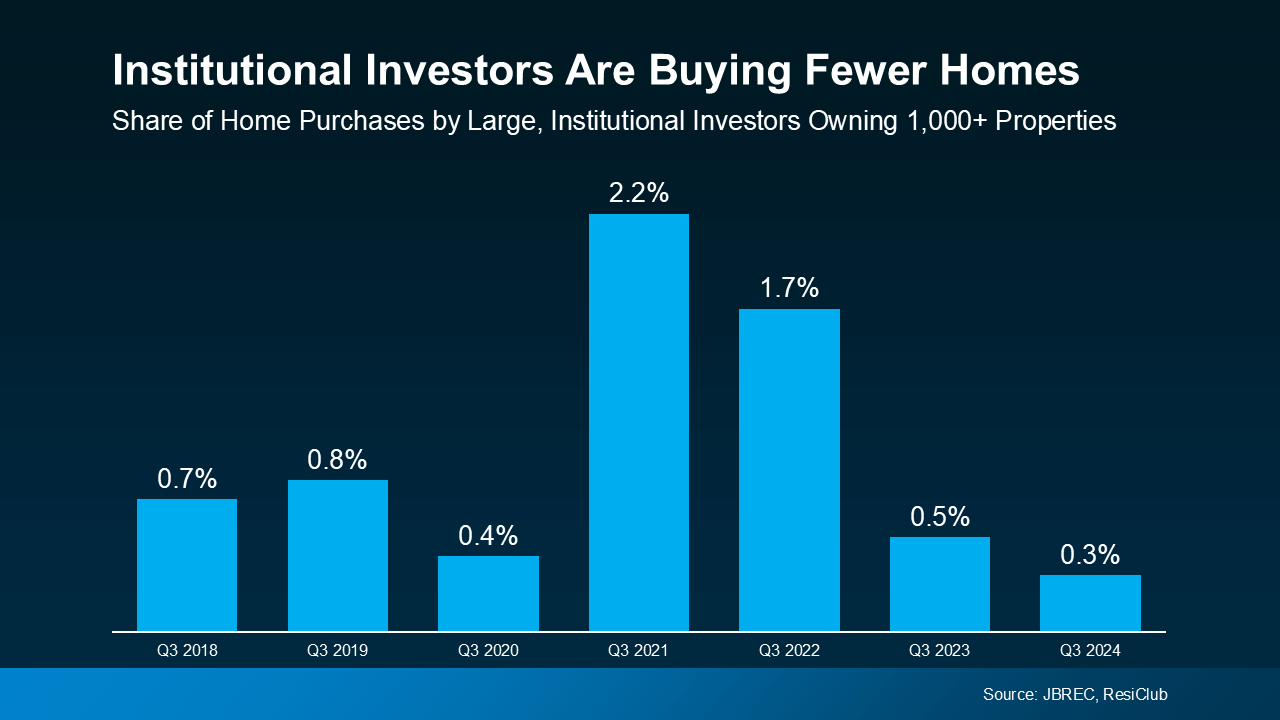
That’s a major shift, and it means far fewer investors are competing in the market now than just a few years ago.

Investors are clearly more reluctant to buy in today’s market, but why? The answer is largely because higher mortgage rates and home prices have made it less attractive for them.

The idea that Wall Street investors are buying up all the homes and making it impossible for you to compete is a myth. While some investors are still in the market, they’re not nearly as active as they were in past years.

Bottom Line

Big institutional investors aren’t buying up all the homes – if anything they’re buying less than they have been. Connect with a local real estate agent to talk about what’s happening in your local market. There could be more opportunities than you think.

How does knowing investors are buying fewer homes change the way you see your chances in today’s market?

Tags:

homesforsalehowtosellahome
Author

emma

Follow Me
Other Articles
Previous

How To Buy a Home Without Waiting for Lower Rates

Next

Is an Accessory Dwelling Unit Right for You? Here’s What To Know

More Links Like Home Value

Home Value/Zero Downpayment

Copyright 2026 — Sell My House. All rights reserved. Blogsy WordPress Theme

Important
This site makes use of cookies which may contain tracking information about visitors. By continuing to browse this site you agree to our use of cookies.

Customize Cookies ×

Necessary
Necessary cookies are required to enable the basic features of this site, such as providing secure log-in or adjusting your consent preferences. These cookies do not store any personally identifiable data.
Cookies
cookie Description Expiry Date
Functional
Functional cookies help perform certain functionalities like sharing the content of the website on social media platforms, collecting feedback, and other third-party features.
Cookies
cookie Description Expiry Date
Analytics
Analytical cookies are used to understand how visitors interact with the website. These cookies help provide information on metrics such as the number of visitors, bounce rate, traffic source, etc.
Cookies
cookie Description Expiry Date
Performance
Performance cookies are used to understand and analyze the key performance indexes of the website which helps in delivering a better user experience for the visitors.
Cookies
cookie Description Expiry Date
Advertisement
Advertisement cookies are used to provide visitors with customized advertisements based on the pages you visited previously and to analyze the effectiveness of the ad campaigns.
Cookies
cookie Description Expiry Date
Others
Other uncategorized cookies are those that are being analyzed and have not been classified into a category as yet.
Cookies
cookie Description Expiry Date